











The Foundation: Understanding What Makes Tweets Get Impressions
Before diving into specific techniques, it's crucial to understand the core principle: People don't want to turn on their brain to consume your content.
If someone has to think hard to understand your tweet, you've already lost 90% of your potential readers. The best tweets are instantly clear, immediately engaging, and effortlessly consumable.
The Two Functions of Content
Every successful tweet serves one of two functions:
- Entertaining - Makes people feel something, laugh, or relate
- Valuable - Teaches something, solves a problem, or provides insights
If your tweet doesn't do one of these, it won't get impressions. It's that simple.
The Anatomy of High-Impression Tweets
Based on analysis of thousands of viral tweets, every high-performing post contains these elements:
1. The Hook (First 5 Words Are Critical)
Your hook is the first line that grabs attention. It must:
- Trigger curiosity or emotion
- Promise value or entertainment
- Be specific (not vague)
- Be instantly clear what the tweet is about
Bad hook: "Day one of taking my Chrome extension to the next level"
Good hook: "Day one of taking my Chrome extension from $3,000 MRR to $50,000 MRR"
The difference? Specificity and a clear promise.
2. Clarity
Within the first second, readers should know exactly what your tweet is about. No ambiguity, no confusion.
3. Promise
What will the reader gain by continuing? Make the value proposition clear immediately.
4. Curiosity Gap
Create a question in the reader's mind that compels them to read on. The hook should make them think: "I need to know more."
5. Structure & Flow
- Use line breaks for rhythm and scannability
- Keep it short (3 lines maximum when possible)
- Make it visually easy to consume
- Use bullets for lists
- No unnecessary filler words
6. Magnet Words
Specific words that create tension, urgency, or interest:
- Numbers: "$100M", "$0", "24 months"
- Power words: "scam", "insane", "stole"
- Specific outcomes: "300K users", "5K daily visits"
- Contrast: "perfectly built yet doomed"
Answer: High-impression tweets contain six key elements: a strong hook in the first 5 words that triggers curiosity or emotion, instant clarity about the topic, a clear promise of value, a curiosity gap that compels reading, proper structure with line breaks and scannability, and magnet words like numbers, power words, and specific outcomes that create tension or interest.
10 Analyzed Tweets: What Makes Them Work
Let's break down 10 real tweets that got massive impressions and understand exactly why they worked.
Tweet Analysis #1: The Contrarian Take
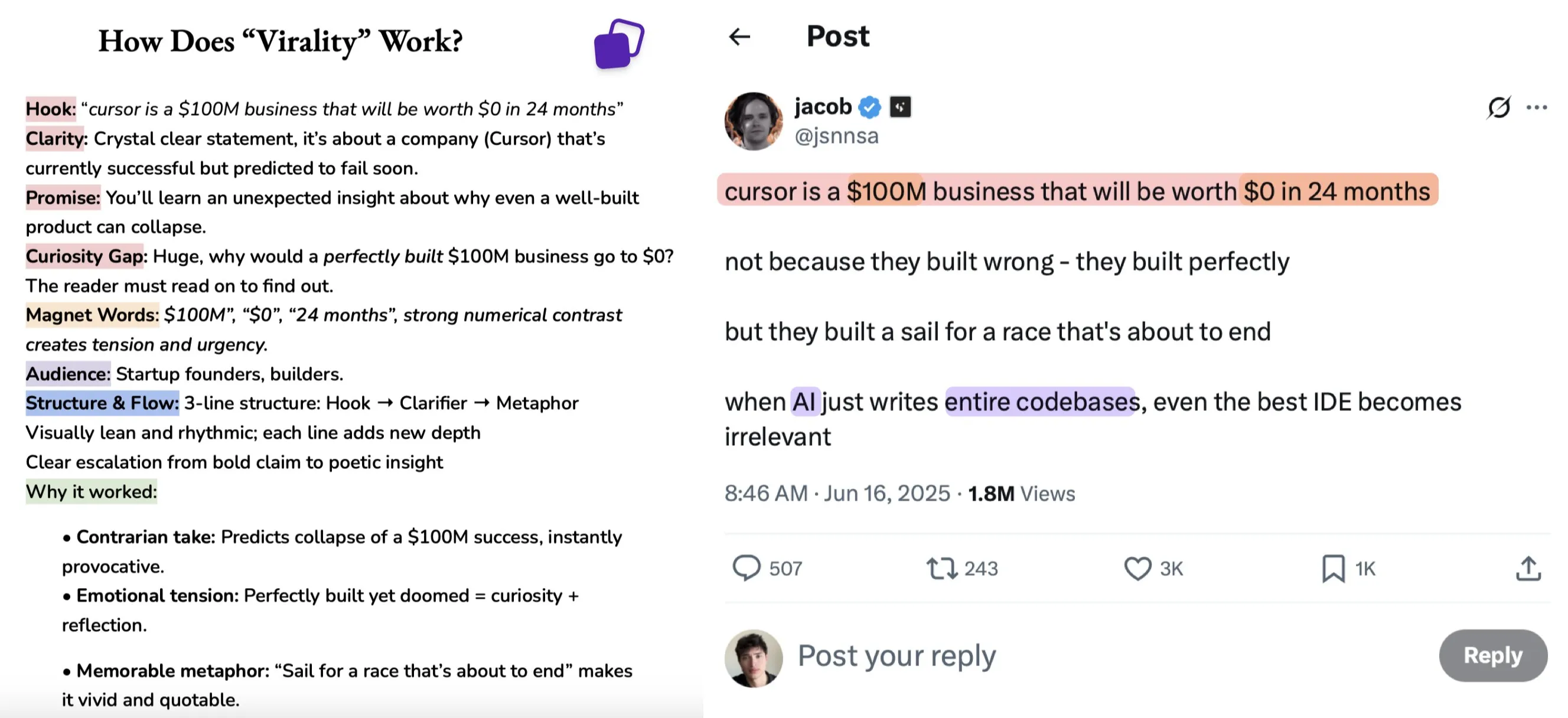
Jacob's tweet about Cursor
Metrics: 1.8M Views, 507 Comments, 243 Retweets, 3K Likes, 1K Bookmarks
Why It Worked:
- Hook: "cursor is a $100M business that will be worth $0 in 24 months" - Instantly provocative, creates massive curiosity gap
- Clarity: Immediately clear this is a contrarian prediction about a well-known product
- Promise: You'll learn an unexpected insight about why even a well-built product can collapse
- Curiosity Gap: "Why would a perfectly built $100M business go to $0?" - Compels you to read on
- Magnet Words: "$100M", "$0", "24 months" - Strong numerical contrast creates tension
- Audience: Startup founders, builders, tech Twitter
- Structure & Flow: 3-line structure: Hook → Clarifier → Metaphor. Visually lean and rhythmic; each line adds new depth. Clear escalation from bold claim to poetic insight
- Why it worked:
- Contrarian take: Predicts collapse of a $100M success, instantly provocative
- Emotional tension: "Perfectly built yet doomed" = curiosity + reflection
- Memorable metaphor: "Sail for a race that's about to end" makes it vivid and quotable
Takeaway: Contrarian takes work when they're well-reasoned and use powerful metaphors. The hook creates immediate tension that demands resolution.
Tweet Analysis #2: The Value-Stacked List
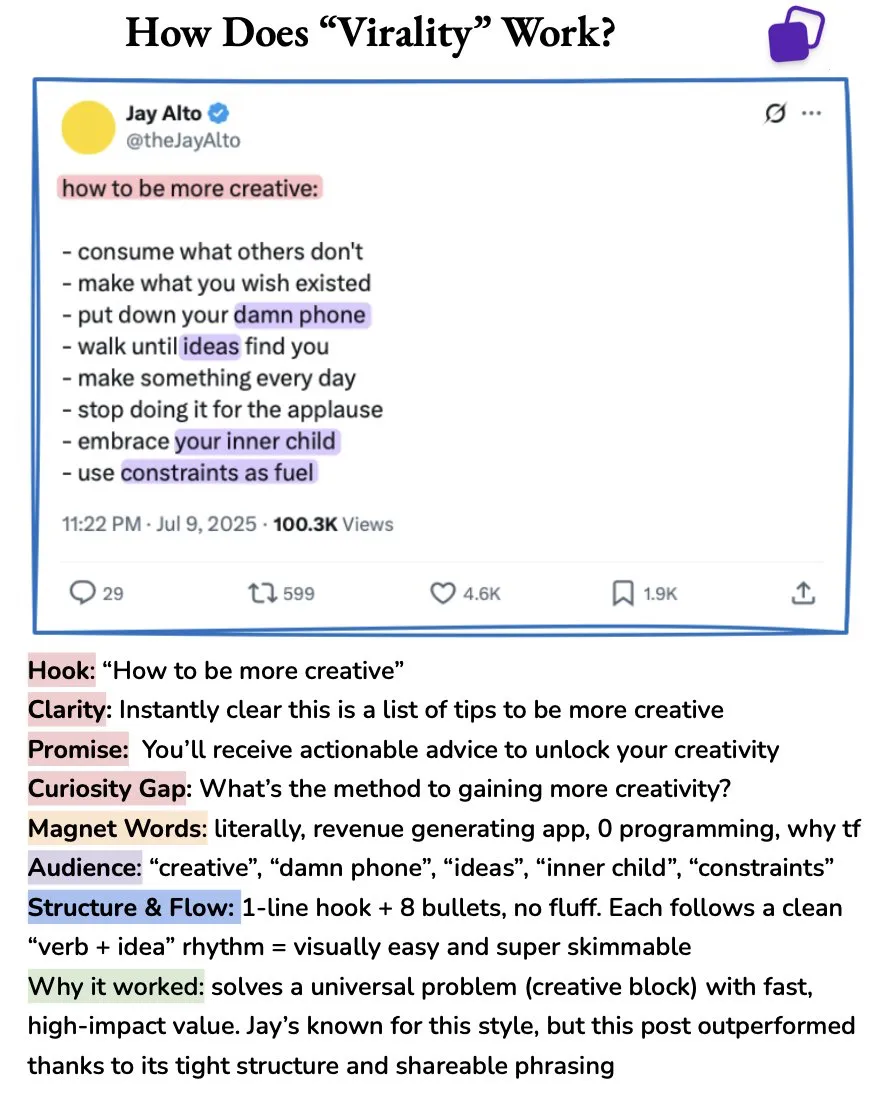
Jay Alto's creativity tips tweet
Metrics: 100.3K Views, 29 Replies, 599 Reposts, 4.6K Likes, 1.9K Bookmarks
Why It Worked:
- Hook: "how to be more creative:" - Clear, actionable promise
- Clarity: Instantly clear this is a list of tips to be more creative
- Promise: You'll receive actionable advice to unlock your creativity
- Curiosity Gap: "What's the method to gaining more creativity?"
- Magnet Words: "damn phone", "ideas", "inner child", "constraints" - Words that resonate with the creative audience
- Audience: Creative professionals, artists, builders, entrepreneurs
- Structure & Flow: 1-line hook + 8 bullets, no fluff. Each follows a clean 'verb + idea' rhythm = visually easy and super skimmable
- Why it worked: Solves a universal problem (creative block) with fast, high-impact value. Tight structure and shareable phrasing make it easy to bookmark and reference
Takeaway: Value-packed lists work when they're scannable, actionable, and solve a universal problem. The structure makes it easy to consume and share.
Tweet Analysis #3: The Educational Thread Hook
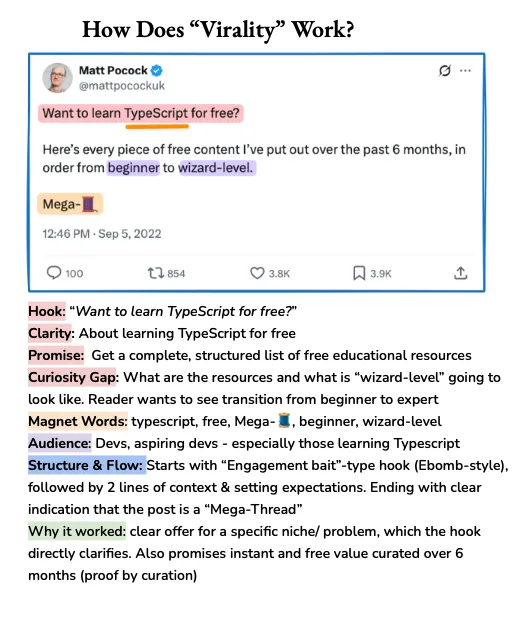
Matt Pocock's TypeScript thread
Metrics: 100 Comments, 854 Retweets, 3.8K Likes, 3.9K Bookmarks
Why It Worked:
- Hook: "Want to learn TypeScript for free?" - Direct question that targets a specific need
- Clarity: About learning TypeScript for free
- Promise: Get a complete, structured list of free educational resources
- Curiosity Gap: "What are the resources and what is 'wizard-level' going to look like?" Reader wants to see transition from beginner to expert
- Magnet Words: "TypeScript", "free", "Mega-🧵", "beginner", "wizard-level"
- Audience: Devs, aspiring devs - especially those learning TypeScript
- Structure & Flow: Starts with engagement-bait-style hook, followed by 2 lines of context & setting expectations. Ending with clear indication that the post is a 'Mega-Thread'
- Why it worked: Clear offer for a specific niche/problem, which the hook directly clarifies. Also promises instant and free value curated over 6 months (proof by curation)
Takeaway: Educational content works when it's highly specific, promises curated value, and uses clear progression language (beginner to expert). The thread format allows for deep value delivery.
Tweet Analysis #4: The Counter-Narrative
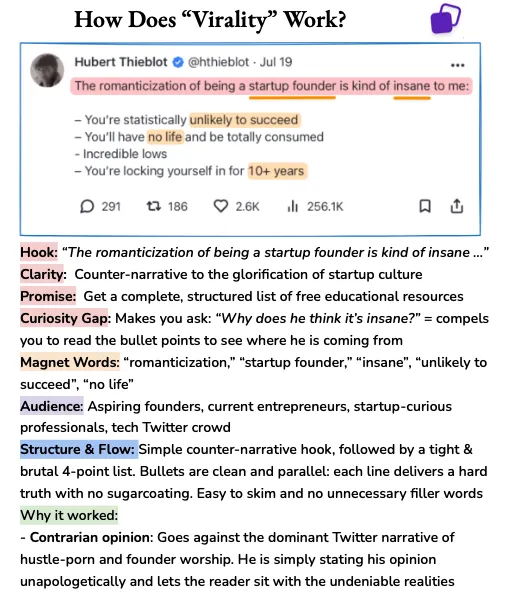
Hubert Thieblot's startup founder tweet
Metrics: 291 Comments, 186 Retweets, 2.6K Likes, 256.1K Impressions
Why It Worked:
- Hook: "The romanticization of being a startup founder is kind of insane to me:" - Counter-narrative hook that challenges dominant narrative
- Clarity: Counter-narrative to the glorification of startup culture
- Promise: Get an honest, unfiltered perspective on startup reality
- Curiosity Gap: "Why does he think it's insane?" = compels you to read the bullet points to see where he is coming from
- Magnet Words: "romanticization", "startup founder", "insane", "unlikely to succeed", "no life"
- Audience: Aspiring founders, current entrepreneurs, startup-curious professionals, tech Twitter crowd
- Structure & Flow: Simple counter-narrative hook, followed by a tight & brutal 4-point list. Bullets are clean and parallel: each line delivers a hard truth with no sugarcoating. Easy to skim and no unnecessary filler words
- Why it worked:
- Contrarian opinion: Goes against the dominant Twitter narrative of hustle-porn and founder worship
- He is simply stating his opinion unapologetically and lets the reader sit with the undeniable realities
Takeaway: Counter-narratives work when they're authentic, well-structured, and challenge popular beliefs. The brutal honesty creates shareability.
Tweet Analysis #5: The Relatable Pain Point
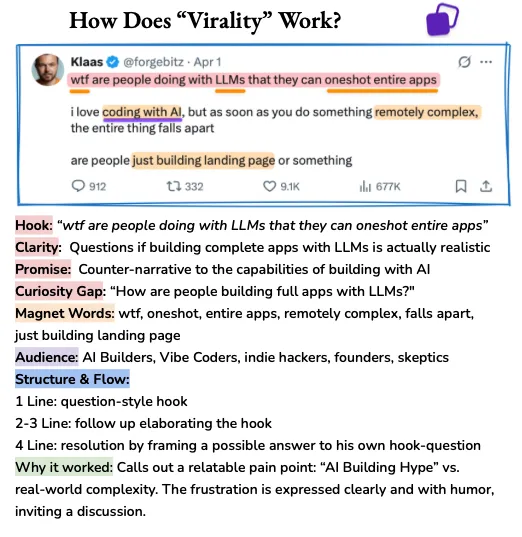
Klaas's LLM coding tweet
Metrics: 912 Replies, 332 Retweets, 9.1K Likes, 677K Impressions
Why It Worked:
- Hook: "wtf are people doing with LLMs that they can oneshot entire apps" - Question-style hook that expresses relatable frustration
- Clarity: Questions if building complete apps with LLMs is actually realistic
- Promise: Counter-narrative to the capabilities of building with AI
- Curiosity Gap: "How are people building full apps with LLMs?"
- Magnet Words: "wtf", "oneshot", "entire apps", "remotely complex", "falls apart", "just building landing page"
- Audience: AI Builders, Vibe Coders, indie hackers, founders, skeptics
- Structure & Flow:
- 1 Line: question-style hook
- 2-3 Line: follow up elaborating the hook
- 4 Line: resolution by framing a possible answer to his own hook-question
- Why it worked: Calls out a relatable pain point: "AI Building Hype" vs. real-world complexity. The frustration is expressed clearly and with humor, inviting a discussion
Takeaway: Relatable pain points work when they're expressed authentically and invite discussion. The question format creates engagement, and the honest frustration resonates with the audience.
Tweet Analysis #6: The Subtle Shade
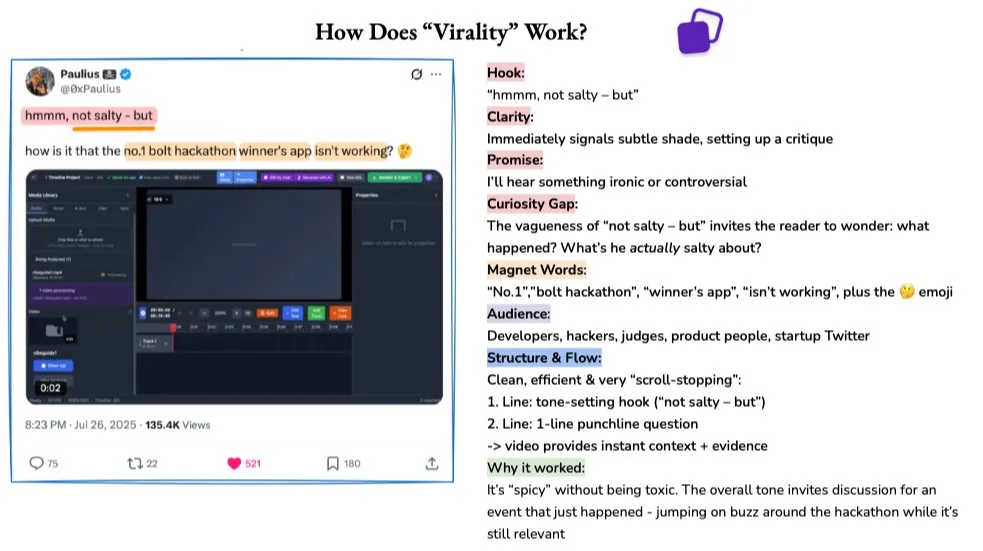
Paulius's hackathon winner tweet
Metrics: 135.4K Views, 75 Comments, 22 Retweets, 521 Likes, 180 Bookmarks
Why It Worked:
- Hook: "hmmm, not salty - but" - Tone-setting hook that signals subtle shade
- Clarity: Immediately signals subtle shade, setting up a critique
- Promise: I'll hear something ironic or controversial
- Curiosity Gap: The vagueness of "not salty - but" invites the reader to wonder: what happened? What's he actually salty about?
- Magnet Words: "No.1", "bolt hackathon", "winner's app", "isn't working", plus the 🤔 emoji
- Audience: Developers, hackers, judges, product people, startup Twitter
- Structure & Flow: Clean, efficient & very "scroll-stopping":
- Line: tone-setting hook ("not salty - but")
- Line: 1-line punchline question
- -> video provides instant context + evidence
- Why it worked: It's "spicy" without being toxic. The overall tone invites discussion for an event that just happened - jumping on buzz around the hackathon while it's still relevant
Takeaway: Subtle shade works when it's timely, has evidence (the video), and invites discussion without being toxic. The "not salty - but" framing is perfect for this.
Tweet Analysis #7: The Provocative Launch
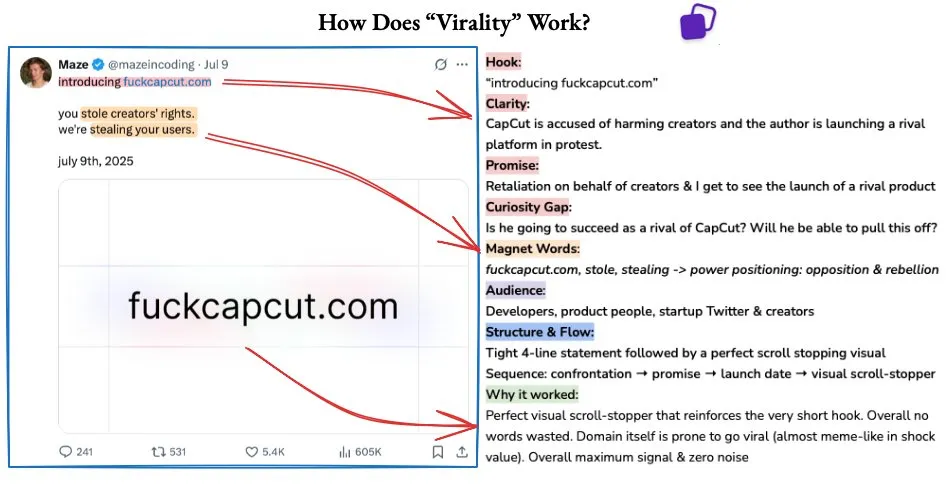
Maze's fuckcapcut.com tweet
Metrics: 241 Comments, 531 Reposts, 5.4K Likes, 605K Impressions
Why It Worked:
- Hook: "introducing fuckcapcut.com" - Provocative domain name that's impossible to ignore
- Clarity: CapCut is accused of harming creators and the author is launching a rival platform in protest
- Promise: Retaliation on behalf of creators & I get to see the launch of a rival product
- Curiosity Gap: "Is he going to succeed as a rival of CapCut? Will he be able to pull this off?"
- Magnet Words: "fuckcapcut.com", "stole", "stealing" -> power positioning: opposition & rebellion
- Audience: Developers, product people, startup Twitter & creators
- Structure & Flow: Tight 4-line statement followed by a perfect scroll-stopping visual. Sequence: confrontation → promise → launch date → visual scroll-stopper
- Why it worked: Perfect visual scroll-stopper that reinforces the very short hook. Overall no words wasted. Domain itself is prone to go viral (almost meme-like in shock value). Overall maximum signal & zero noise
Takeaway: Provocative launches work when they have a clear enemy, a righteous cause, and visual reinforcement. The domain name itself becomes the hook.
Tweet Analysis #8: The Success Story Hook
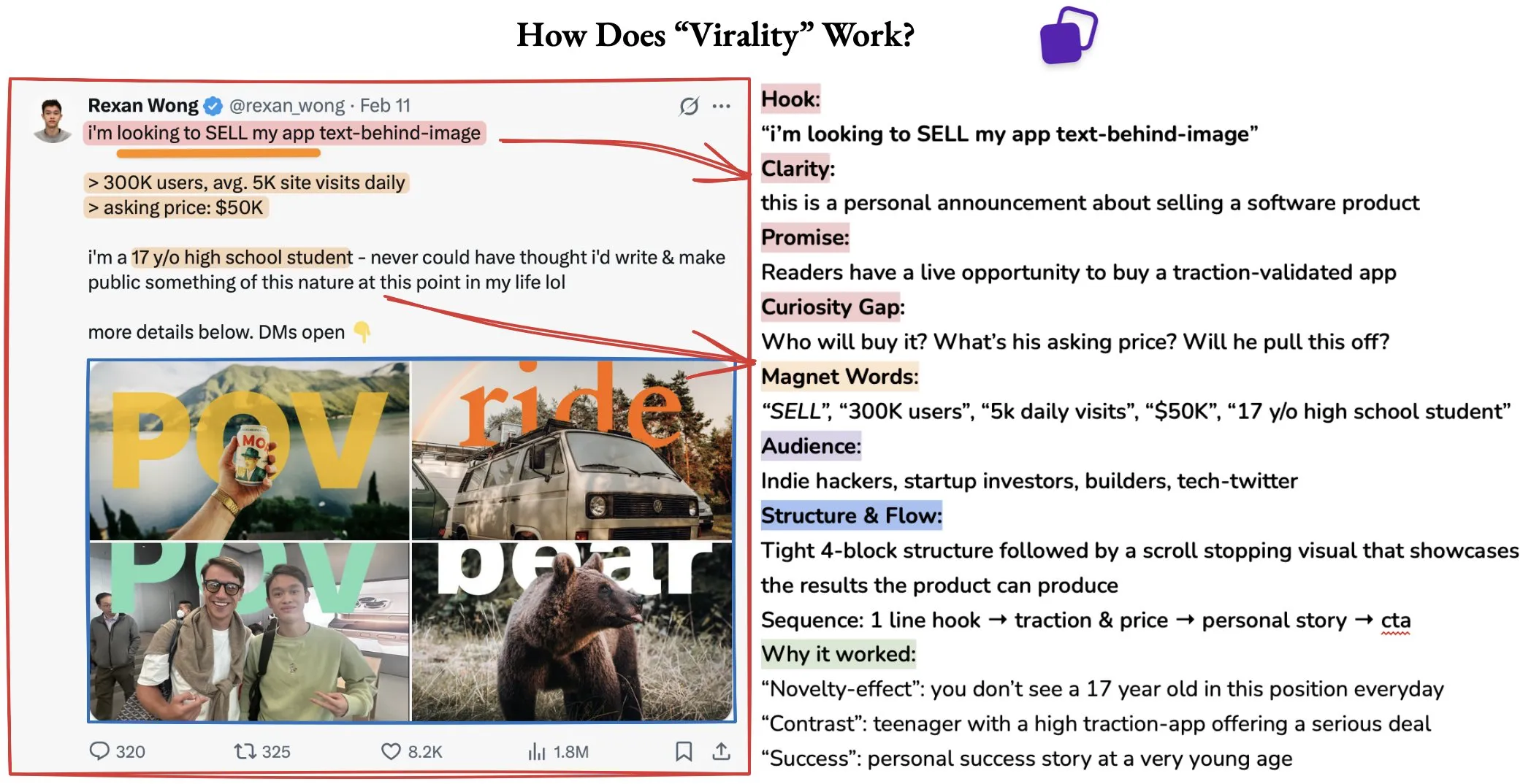
Rexan Wong's app sale tweet
Metrics: 320 Comments, 325 Retweets, 8.2K Likes, 1.8M Impressions
Why It Worked:
- Hook: "i'm looking to SELL my app text-behind-image" - Direct announcement with clear action
- Clarity: This is a personal announcement about selling a software product
- Promise: Readers have a live opportunity to buy a traction-validated app
- Curiosity Gap: "Who will buy it? What's his asking price? Will he pull this off?" (Especially given he's 17)
- Magnet Words: "SELL", "300K users", "5k daily visits", "$50K", "17 y/o high school student"
- Audience: Indie hackers, startup investors, builders, tech-twitter
- Structure & Flow: Tight 4-block structure followed by a scroll-stopping visual that showcases the results the product can produce. Sequence: 1 line hook → traction & price → personal story → CTA
- Why it worked:
- Novelty-effect: "you don't see a 17 year old in this position everyday"
- Contrast: "teenager with a high traction-app offering a serious deal"
- Success: "personal success story at a very young age"
Takeaway: Success stories work when they have novelty (17 years old), clear metrics (300K users), and visual proof. The contrast between age and achievement creates the hook.
Tweet Analysis #9: The Trend Critique
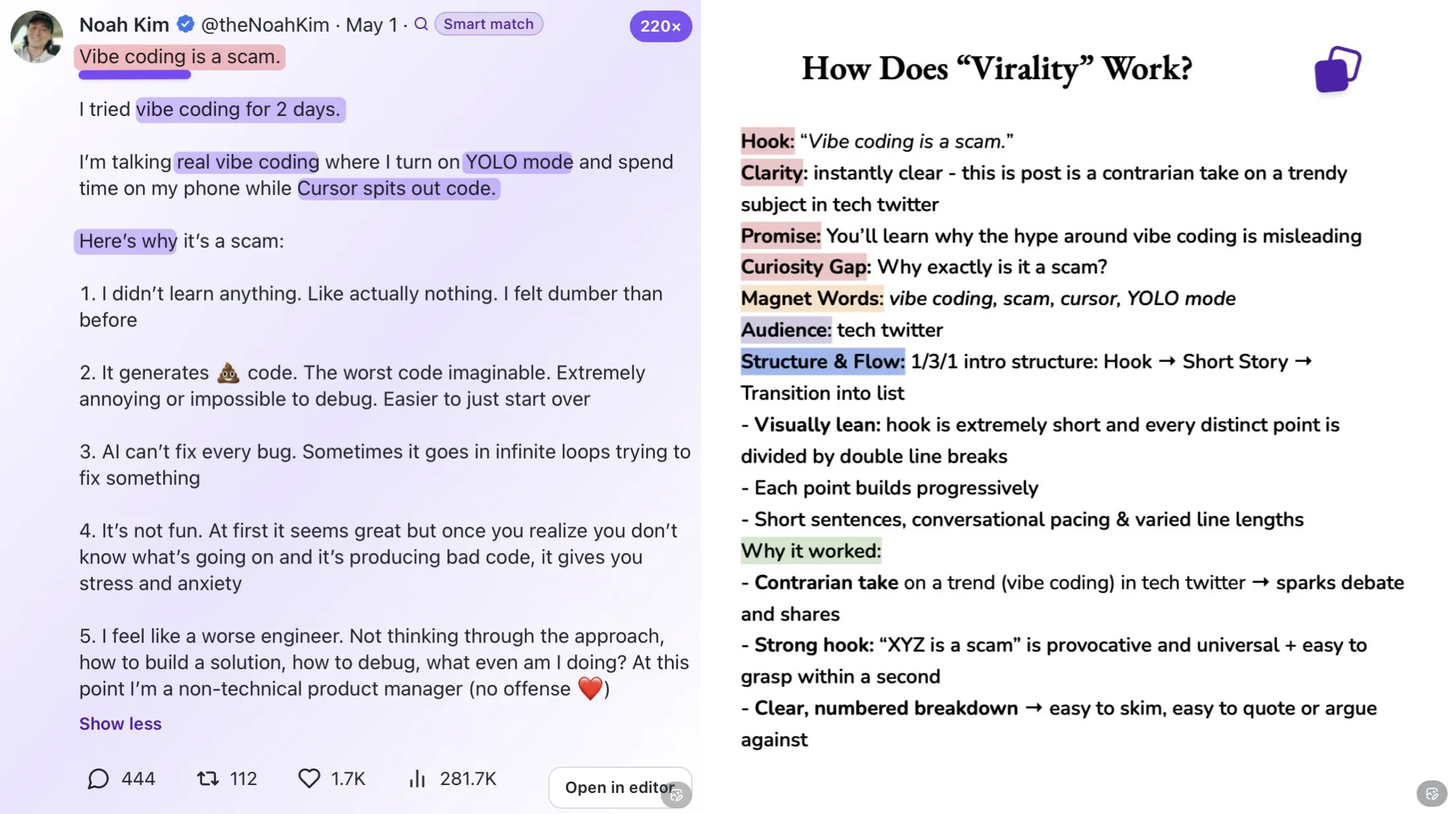
Noah Kim's vibe coding tweet
Metrics: 444 Comments, 112 Retweets, 1.7K Likes, 281.7K Impressions
Why It Worked:
- Hook: "Vibe coding is a scam." - Strong, provocative hook that challenges a trend
- Clarity: Instantly clear - this post is a contrarian take on a trendy subject in tech twitter
- Promise: You'll learn why the hype around vibe coding is misleading
- Curiosity Gap: "Why exactly is it a scam?"
- Magnet Words: "vibe coding", "scam", "cursor", "YOLO mode"
- Audience: Tech twitter, developers, AI builders
- Structure & Flow:
- 1/3/1 intro structure: Hook → Short Story → Transition into list
- Visually lean: hook is extremely short and every distinct point is divided by double line breaks
- Each point builds progressively
- Short sentences, conversational pacing & varied line lengths
- Why it worked:
- Contrarian take on a trend (vibe coding) in tech twitter → sparks debate and shares
- Strong hook: "XYZ is a scam" is provocative and universal + easy to grasp within a second
- Clear, numbered breakdown → easy to skim, easy to quote or argue against
Takeaway: Trend critiques work when they're based on personal experience, well-structured, and invite debate. The numbered list makes it easy to engage with specific points.
Tweet Analysis #10: The Authentic Story
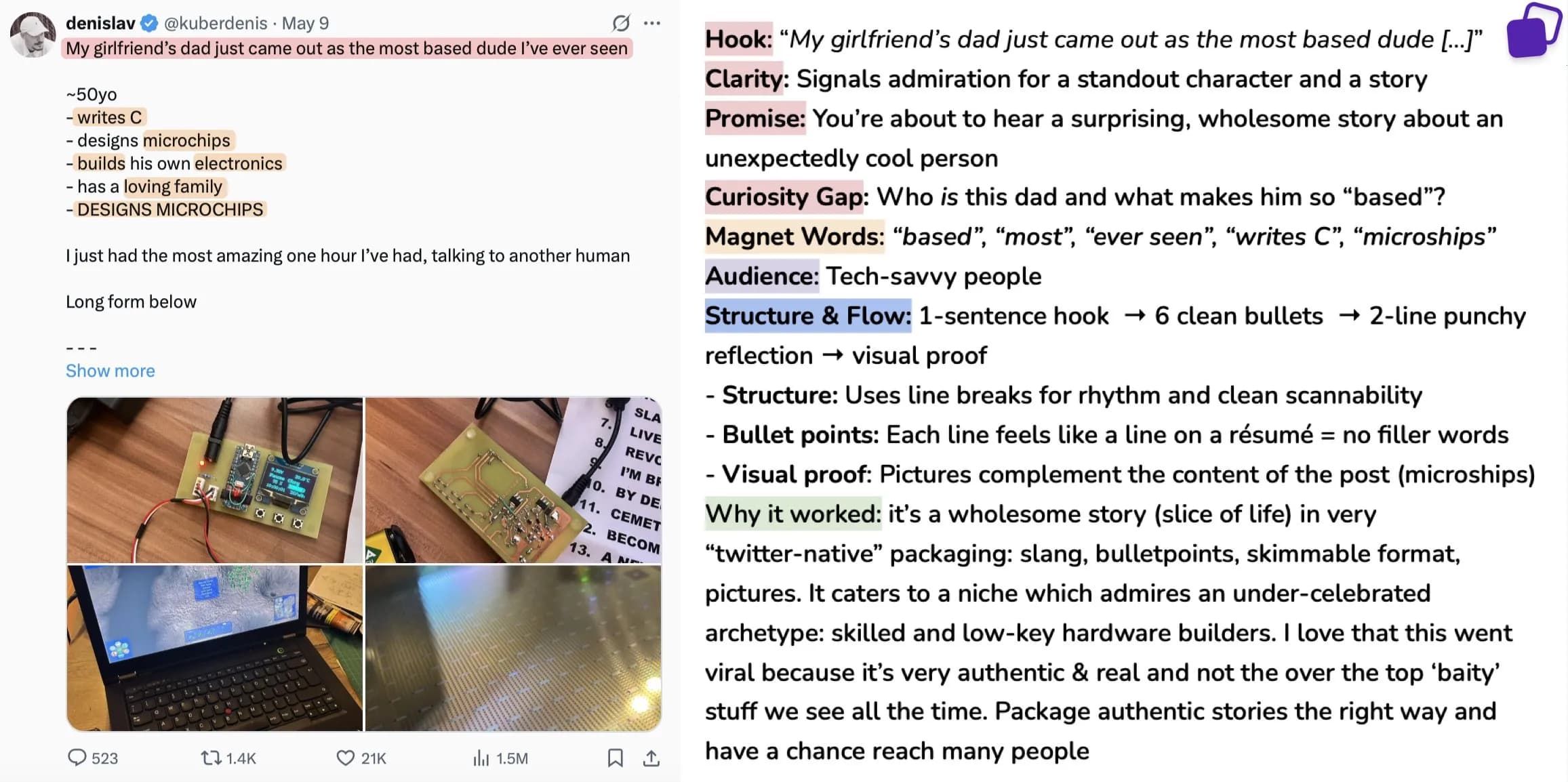
Denislav's girlfriend's dad tweet
Metrics: 523 Replies, 1.4K Retweets, 21K Likes, 1.5M Impressions
Why It Worked:
- Hook: "My girlfriend's dad just came out as the most based dude I've ever seen" - Personal story hook with admiration
- Clarity: Signals admiration for a standout character and a story
- Promise: You're about to hear a surprising, wholesome story about an unexpectedly cool person
- Curiosity Gap: "Who is this dad and what makes him so 'based'?"
- Magnet Words: "based", "most", "ever seen", "writes C", "microchips"
- Audience: Tech-savvy people, hardware enthusiasts, developers
- Structure & Flow: 1-sentence hook → 6 clean bullets → 2-line punchy reflection → visual proof. Uses line breaks for rhythm and clean scannability. Each line feels like a line on a résumé = no filler words. Pictures complement the content of the post (microchips)
- Why it worked:
- It's a wholesome story (slice of life) in very 'twitter-native' packaging: slang, bulletpoints, skimmable format, pictures
- It caters to a niche which admires an under-celebrated archetype: skilled and low-key hardware builders
- It went viral because it's very authentic & real and not the over the top 'baity' stuff we see all the time
- Package authentic stories the right way and have a chance reach many people
Takeaway: Authentic stories work when they're genuinely interesting, well-packaged, and celebrate under-appreciated archetypes. The visual proof (microchip photos) reinforces the story.
The Writing Framework: How to Structure Your Tweets
Based on the analysis above and hundreds of hours of customer conversations, here's the proven framework for writing tweets that get impressions:
Step 1: Start with a Strong Hook (First 5 Words)
Your hook must:
- Be specific (not vague)
- Create curiosity or emotion
- Promise value
- Be instantly clear
Formula: [Specific Outcome/Claim] + [Emotion/Curiosity Trigger]
Examples:
- "Day one of taking my Chrome extension from $3K to $50K MRR"
- "Vibe coding is a scam"
- "cursor is a $100M business that will be worth $0 in 24 months"
Step 2: Add Clarity (Next 1-2 Lines)
Immediately clarify what the tweet is about. No ambiguity.
Step 3: Structure for Scannability
- Use line breaks (double line breaks between sections)
- Keep paragraphs to 1-2 lines max
- Use bullets for lists
- No unnecessary words
Step 4: Include Magnet Words
Add specific words that create interest:
- Numbers: "$100M", "300K users", "24 months"
- Power words: "scam", "insane", "stole"
- Specific outcomes: "5K daily visits", "wizard-level"
- Contrast: "perfectly built yet doomed"
Step 5: End with a Clear Promise or CTA
What should the reader do next? Or what will they gain?
Answer: The proven framework for writing tweets that get impressions involves five steps: starting with a strong hook in the first 5 words that's specific and creates curiosity, adding clarity in the next 1-2 lines, structuring for scannability with line breaks and short paragraphs, including magnet words like numbers and power words, and ending with a clear promise or CTA.
Streamline your content creation and grow your business with valuable content
Common Mistakes That Kill Impressions
1. Walls of Text
Bad:
I've been thinking about this for a while and I think that when it comes to building products, there are a lot of things that people don't talk about. One of the most important things is that you need to really understand your users and what they want. I've seen so many products fail because they didn't do this properly.
Good:
Most products fail because founders don't understand this:
Your users don't want your product. They want the outcome your product provides.
Build for outcomes, not features.
2. Vague Hooks
Bad: "Day one of taking my app to the next level"
Good: "Day one of taking my app from $3K to $50K MRR"
3. No Structure
Bad: One long paragraph with no breaks
Good: Short lines with double line breaks, bullets for lists
4. Missing the Promise
Bad: Rambling without clear value
Good: Clear promise in the first line
5. Too Long
Rule: If you have to turn on your brain to understand it, you've already lost 90% of readers.
Keep it to 3 lines when possible. If you need more, use threads.
Answer: Common mistakes that kill impressions include writing walls of text instead of scannable content, using vague hooks instead of specific ones, lacking structure with no line breaks, missing a clear promise of value, and making tweets too long or complex. Keep tweets to 3 lines when possible and use threads for longer content.
Advanced Techniques: Tweet Hooks That Get More Impressions
1. The Contrarian Hook
Challenge a popular belief:
- "Vibe coding is a scam"
- "The romanticization of being a startup founder is kind of insane to me"
- "cursor is a $100M business that will be worth $0 in 24 months"
2. The Question Hook
Ask a question that creates curiosity:
- "wtf are people doing with LLMs that they can oneshot entire apps"
- "Want to learn TypeScript for free?"
- "how is it that the no.1 bolt hackathon winner's app isn't working?"
3. The Specific Outcome Hook
Use concrete numbers and outcomes:
- "Day one of taking my Chrome extension from $3K to $50K MRR"
- "i'm looking to SELL my app text-behind-image > 300K users, avg. 5K site visits daily > asking price: $50K"
4. The Story Hook
Start with a personal story:
- "My girlfriend's dad just came out as the most based dude I've ever seen"
- "I tried vibe coding for 2 days"
5. The Provocative Hook
Use strong language (sparingly):
- "introducing fuckcapcut.com"
- "Vibe coding is a scam"
Answer: Advanced tweet hooks that get more impressions include the contrarian hook (challenging popular beliefs), the question hook (asking curiosity-driven questions), the specific outcome hook (using concrete numbers and results), the story hook (starting with personal narratives), and the provocative hook (using strong language sparingly). Each hook type works by creating immediate interest and compelling readers to continue.
Content Ideas for X: Proven Formats That Get Impressions
Based on the analysis, here are formats that consistently work:
1. Value-Stacked Lists
- "how to be more creative:" + 8 actionable tips
- Works because: Solves universal problems, easy to scan, shareable
2. Counter-Narratives
- Challenge popular beliefs with honest takes
- Works because: Creates discussion, stands out, authentic
3. Educational Threads
- "Want to learn [topic] for free? Here's everything..."
- Works because: Curated value, specific niche, clear progression
4. Success Stories
- Personal wins with specific metrics
- Works because: Inspiring, proof of concept, relatable
5. Relatable Pain Points
- Express frustration about common problems
- Works because: Creates connection, invites discussion
6. Authentic Stories
- Real experiences with interesting people/events
- Works because: Genuine, memorable, shareable
Answer: Proven content formats that get impressions on X include value-stacked lists (solving universal problems), counter-narratives (challenging popular beliefs), educational threads (curated value for specific niches) - use Postel's tweet thread maker to create engaging threads, success stories (personal wins with metrics), relatable pain points (expressing common frustrations), and authentic stories (real experiences). Explore viral tweet templates to discover more proven formats. These formats work because they're either valuable, entertaining, or create emotional connections.
The 80/20 Rule for Tweet Writing
80% of your content should use formats you know work:
- Value lists
- Counter-narratives
- Success stories
- Educational content - Use Postel's AI tweet writer to create educational content efficiently
20% of your content should be experiments:
- New formats you haven't tried - Explore viral tweet templates for inspiration
- Things that make you slightly uncomfortable
- Ideas you're not sure will work
This balance ensures consistent performance while discovering new winning formats.
Answer: Follow the 80/20 rule for tweet writing: 80% of your content should use proven formats like value lists, counter-narratives, success stories, and educational content, while 20% should be experiments with new formats, uncomfortable ideas, or untested concepts. This balance ensures consistent performance while discovering new winning formats.
Action Plan: Write Your First High-Impression Tweet
Step 1: Choose Your Format
Pick one from the proven formats above.
Step 2: Write Your Hook
- First 5 words must grab attention
- Be specific, not vague
- Create curiosity or emotion
Step 3: Add Clarity
- Next 1-2 lines explain what the tweet is about
- No ambiguity
Step 4: Structure It
- Use line breaks
- Keep paragraphs short
- Use bullets if listing
- Add magnet words (numbers, power words, specific outcomes)
Step 5: Review
Ask yourself:
- Is this instantly clear?
- Does it promise value or entertainment?
- Is it easy to scan?
- Would I want to read this?
Step 6: Post and Analyze
- Track which formats work
- Double down on what performs - Explore viral tweet templates to discover proven formats
- Keep experimenting - Use Postel's AI tweet writer to create variations of winning formats
Answer: To write your first high-impression tweet, choose a proven format, write a strong hook in the first 5 words that's specific and creates curiosity, add clarity in the next 1-2 lines, structure it with line breaks and magnet words, review it for clarity and value, then post and analyze what works to double down on winning formats.
Streamline your content creation and grow your business with valuable content
Key Takeaways: Proven Tweet Hooks You Can Use
-
Be specific, not vague - "from $3K to $50K MRR" beats "to the next level"
-
Create curiosity gaps - Make people ask "I need to know more"
-
Use structure - Line breaks, bullets, short paragraphs
-
Include magnet words - Numbers, power words, specific outcomes
-
Promise value - Make it clear what readers will gain
-
Keep it short - 3 lines when possible, use threads for more
-
Be authentic - Real stories and honest takes perform best
-
Stand out - Counter-narratives and unique angles get attention
-
Make it scannable - People don't want to think hard
-
Test and iterate - Use 80/20 rule: proven formats + experiments
Answer: Key takeaways for writing tweets that get impressions include being specific rather than vague, creating curiosity gaps, using proper structure with line breaks and bullets, including magnet words like numbers and power words, promising clear value, keeping tweets short (3 lines when possible), being authentic with real stories, standing out with counter-narratives, making content scannable, and testing and iterating with the 80/20 rule.
Conclusion: Unlock the Secret to Successful Content Strategy
Writing tweets that get impressions isn't about gaming the algorithm or using secret tricks. It's about:
- Understanding human psychology - People want value or entertainment, delivered quickly
- Using proven structures - Hooks, clarity, promise, curiosity gaps
- Being specific - Concrete outcomes beat vague promises
- Making it easy to consume - Structure, line breaks, scannability
- Staying authentic - Real stories and honest takes resonate
The 10 analyzed tweets above prove these principles work. They got millions of impressions because they followed these patterns.
Start today. Pick one format, write one tweet using this framework, and post it. Then analyze what works and double down.
Remember: Every viral tweet started as a single post. The difference between posts that get ignored and posts that get millions of impressions? Structure, clarity, and a hook that demands attention.
Now you have the step-by-step guide. Go write tweets that get impressions.
Want to learn more about growing on X? This guide is based on analysis of thousands of high-performing tweets and hundreds of hours of customer conversations with creators who've successfully built thriving communities on X.